
Adaptive Volumetric Streaming for Spatial Videography
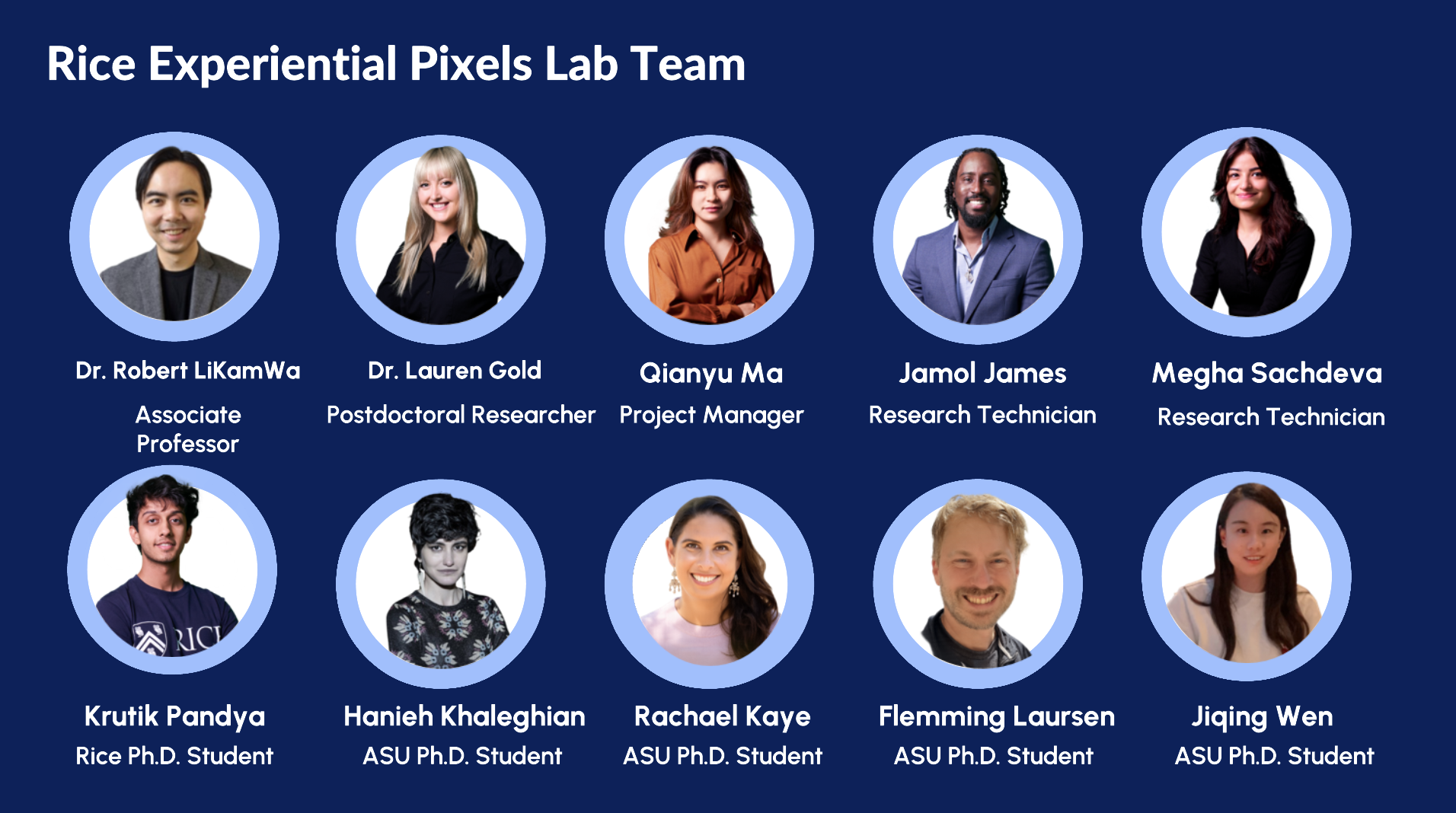
Team Advisor/PI
Project Description/ Research Team Goals
This project explores how real-time volumetric capture and immersive display systems can enable remote athletic training with a shared sense of physical presence.
The system functions as a “4D Zoom” for human performance, connecting multiple physical spaces so that athletes and coaches can see, respond to, and interact with full-body motion as if they were co-located.
This project investigates how real-time volumetric capture and immersive display systems can enable embodied, whole-body feedback for athletic training across both co-located and distributed physical spaces. The system provides navigable, three-dimensional representations of human motion that preserve spatial context, timing, and scale. The platform functions as a “4D Zoom” for human performance, allowing athletes and coaches to observe, compare, and interact with full-body motion.
The proposed platform integrates a real-time volumetric capture pipeline that reconstructs 3D human motion from multiple sensors with immersive display modalities—including projection-based “magic mirrors,” screens, and VR/AR headsets/glasses—that act as portals into another space. Students on the VIP team will work in interdisciplinary subgroups spanning volumetric capture and sensing (e.g., multi-camera calibration, depth fusion, capture architecture, hardware), emerging real-time rendering techniques and visualization tools (e.g., NeRFs, Splats, skeletal overlays, motion comparison), and systems and networking (e.g., latency analysis, low-latency streaming, synchronization). Students will have opportunities to contribute to peer-reviewed publications and to design and conduct human-centered user studies evaluating immersive training systems.
Issues Addressed
- Insufficient spatial representation of human motion, as existing 2D and 360° video methods fail to support interactive, volumetric analysis.
- End-to-end latency challenges in real-time volumetric capture and streaming systems.
- Limitations of current 3D/4D capture architectures in terms of deployability, flexibility, and real-time operation.
Research Methods and Technology
- Volumetric Capture
- Real-Time Rendering
- Distributed Systems
- Immersive Displays
- Networking
- Visualization
- Human-Centered Evaluation
Preferred Undergraduate Interests
- Graphics and Rendering Pipelines
- 3D Capture and Processing
- Networking
- Multiuser Systems
- Volumetric Media Capture, Lighting, and Visual Storytelling (Photography / Film)
- Perception, Embodiment, and Presence (Psychology)
- Biomechanical Analysis and Movement Evaluation (Kinesiology)
Academic Majors of Interest
Open to all majors
Prior Preparation/Requisite Experience
None required
Compensation
Work study-eligible students may receive compensation from OURI.
Course Credit
ELEC 491
ELEC 591
Team Meeting
Weekly meetings, time TBD
Actively Onboarding New Members
Yes
Ready to Apply?
Use the linked Google Form to submit your application!
Contact
For more information, please contact Dr. Robert LiKamWa (likamwa@rice.edu).